


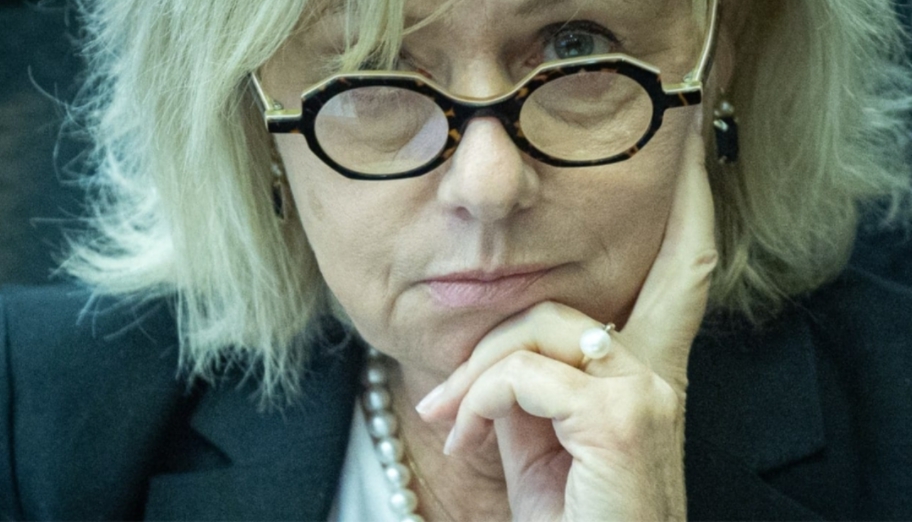
Attorney general Gali Baharav Miara attends a Constitution, Law and Justice Committee leads a committee meeting in the Knesset in Jerusalem.
(photo credit: YONATAN SINDEL/FLASH90) via TJP
By Zvika Klein
Editor’s Notes: “I’ve been pretty quiet since I was released from house arrest and received tremendous support from Israelis. But on Friday, I almost lost it.”
I knew something was off the moment the detectives from Lahav 433 waved me into the interrogation room back in April. No warrant. No polite request.
Just two gloved hands scooping up the two phones that hold years of source material, “evidence,” they called it, and a grey metal chair that would be mine for the next 12 hours.
By nightfall, I was on five days of house arrest and gagged from speaking publicly. Three months later, both phones are still locked in a police vault, and carefully edited leaks from them have already reached rival newsrooms.
I’ve been pretty quiet since I was released from house arrest and received tremendous support from Israelis from all walks of life. But on Friday, I almost lost it: Channel 13’s legal correspondent Aviad Glickman was caught on camera shoving Gal Dabush, an aide to Sara Netanyahu, in a courthouse corridor.
Within six weeks, he, too, was summoned for questioning until Attorney-General Gali Baharav-Miara slammed on the brakes. An “urgent consultation,” she explained, is required whenever police contemplate investigating a journalist for conduct linked to their work; anything less might “chill the press.”
 JERUSALEM POST Editor-in-Chief Zvika Klein. (credit: ISRAEL BARDUGO) via TJP
National Security Minister Itamar Ben-Gvir called the move a “made-to-measure pardon for friends in the media.” For once, the minister had a point. The same system that hauled me in, leaked against me, and still withholds my equipment, suddenly decides it must tread gingerly. Evidently, some microphones come pre-wrapped in Kevlar.
The hypocrisy up close
Here is what keeps me up at night: the woman who lectures the nation about “careful, proportionate enforcement” now behaves like a wounded animal, lashing out at anything that steps onto her path of self-preservation. And I happened to be in her way. The damage to my reputation, to my family’s peace of mind? Collateral.
The thousands of Israelis who now believe she has lost all sense of fairness?
Background noise.
I have watched veterans of the legal establishment, police investigators, courtroom clerks, even judges, whisper that the A-G’s credibility is in free fall.
They see what the public sees: rules invoked one week, ignored the next; secrecy for friends, sunshine for enemies. If legitimacy is a currency, she is overdrawing the national account.
Israel’s attorney-general doubles as both chief prosecutor and chief legal adviser, a concentration of power rare in other democracies. That power can be tolerated only when it is exercised with strict neutrality. Selective mercy guts the legitimacy it is meant to protect.
Baharav-Miara cited two documents: Police Procedure 300.01.227 (“Summoning a Journalist for Interrogation and Conducting a Search”) and State Attorney Guideline 14.12 (“Approval for Opening an Investigation and Indicting in Matters of Special Sensitivity”).
Both say the same thing: Before police pry into a reporter’s notebook, senior sign-off is mandatory. Those safeguards, however, were nowhere to be found during the Pegasus-spyware scandal, nor when right-leaning outlets were hauled into court on libel claims.
Nor was it applied in my case. Many journalists asked the A-G to see a warrant or understand whether she allowed the interrogation to happen – she wouldn’t answer them for days.
Only now, for Glickman, do they become holy writ. Nor is the Glickman affair a textbook clash between the Fourth Estate and state power.
The shove happened in plain sight, the alleged victim is a private citizen, and the dispute is as mundane as they come. If proportionality is the issue, let a magistrate decide, without the attorney-general acting as a one-person court of equity.
How we got here
In my own case, playfully dubbed “Qatargate,” investigators threw at me vague accusations of “contact with a foreign agent.” When I asked who, they produced lobbyist Jay Footlik.
When reminded that lobbyists are not spies, they pivoted to “someone from Qatar.” The Gulf state, last time I checked, is not an enemy country. None of this mattered; the narrative had already been seeded.
Selected snippets from my seized phone were published by Ynet, followed by talking points provided to sympathetic reporters. I am not guessing; I know exactly who made the calls.
So yes, forgive me if I raise an eyebrow when the same gatekeepers invoke “journalistic chill” to rescue a better-connected peer from a routine assault probe.
Public trust in the justice system is already at an all-time low. Every time the rules bend for a high-profile figure, the silent majority concludes that the game is fixed.
In a country as polarized as ours, unequal enforcement is fuel, not water, on the fire. Abroad, allies who defend our judiciary in Washington and Brussels are left fumbling when legal standards appear to sway with media clout.
Press freedom is not a private clubhouse. Either every journalist benefits from due-process safeguards, or the shield is a mirage. By stepping in selectively, the attorney-general has turned a policy designed to protect journalism into a partisan privilege, undermining the very institution she leads.
Justice in Israel must remain impartial, even under the brightest stadium lighting. Otherwise, the next time a reporter hears a late-night knock, the public will wonder not: “What did they do?” but “Whose side are they on?”
Not all by myself
I’m not entirely alone, though. Haim Har-Zahav, the newly elected chair of the Journalists’ Association, wrote to me this week that my arrest was “one of the main reasons I decided to run.”
In his words, the organization “simply wasn’t there for you, an Israeli reporter hauled in for his work, and it failed in its duty to stand up, fight your fight and protect you.” He added an unequivocal pledge: Under his watch, the association “will never again be so passive if any journalist, of any political stripe, is dragged into a similar ordeal.”
Har-Zahav ended with an apology “from the depths of my heart” and a promise that “journalists must never be arrested because of their reporting – period.” His message doesn’t erase three months of legal limbo or the toll on my family, but it does prove that the hypocrisy I’ve described is now sparking change inside the very institutions that once looked the other way.
The pile-on didn’t stop at press releases. After an interview on KAN radio right after being released from house arrest, the association, which wasn’t very supportive in the first place, criticized me publicly.
“Instead of backing: Journalists’ Association scolds Zvika Klein,” an article by Srugim News quoted the association insisting that “a journalist must never reveal his sources” and lecturing that reporters “are not meant to coordinate transfers of money between third parties.”
Anyone skimming the piece would assume I had confessed to laundering Qatari cash. The nuance, that I disclosed contacts only under relentless questioning and never moved a single shekel, was buried beneath a photo caption accusing me of “exposing [my] sources and involvement in the affair.”
That public shaming, amplified by 20 snide talk-backs, drove home how thoroughly the association had internalized the prosecution’s narrative. The body that should have asked why detectives needed two phones full of privileged data chose instead to chide me for “burning” sources and to warn other reporters against following in my supposed footsteps.
Small wonder so many colleagues now whisper that the A-G’s office – and the institutions that orbit it – are ”fighting their last fight,” lashing out at whoever happens to stand in the way.
While I was finishing up writing this column on Thursday, I received another text message that made my day. It was an interview with Har-Zahav on Galei Israel radio, where he publicly acknowledged his organization’s failure: “The investigation of Zvika Klein is a disgrace. A journalist who comes voluntarily to give testimony and then finds himself under interrogation, that’s surreal,” he said.
“I’m telling you plainly, the [Journalists’] Association acted improperly – and I pledge to every journalist in Israel that we will stand by them,” Har-Zahav concluded.
During an interview I gave this week to Channel 12 News, a number of journalists, from the political Right as well as the Left, all spoke negatively about the A-G decision in my case. They spoke up in my support and in support of other journalists whose rights were ignored bluntly.
Acknowledging a mistake or a problem is, in my opinion, the first and important step to change – and I truly hope that this change is tangible and real. – TJP
Share your thoughts on the story I Saw Israel’s Attorney‑General Bend The Law For Her Favorites, And I Paid The Price – Comment with Nigerian Kicker in the comments section.